
Two Governments Agree on Stablecoins. The BIS Isn't Buying It.
More than 2,000 institutions now hold Bitcoin through spot ETFs

The US and UK Just Signed On to the Same Stablecoin Rulebook
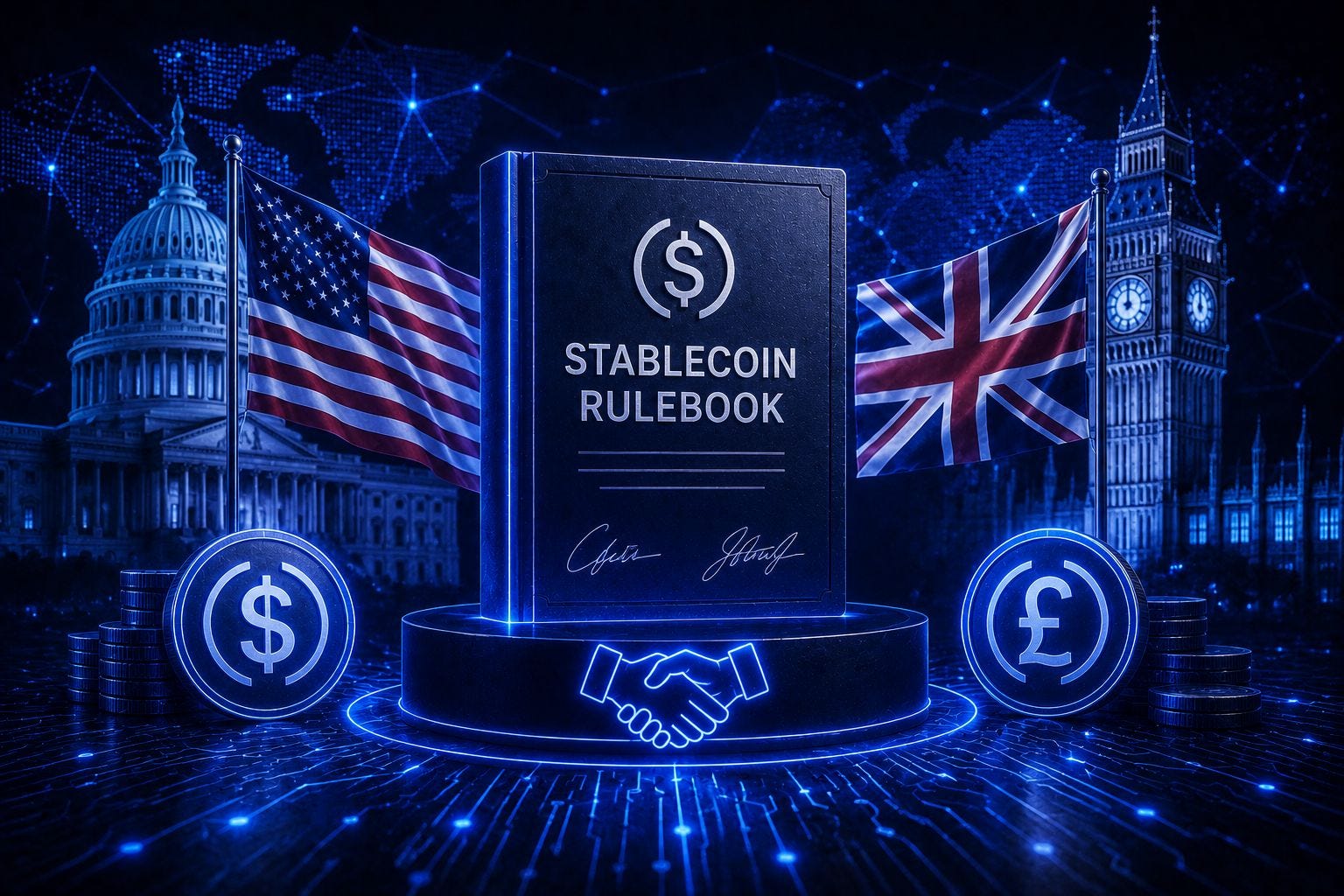
The most significant concrete deliverable from the endeavour that Scott Bessent and Rachel Reeves initiated in September 2025 is a joint statement by the US Treasury and the UK’s HM Treasury published on July 14.
Both governments want stablecoin reserves to be fully backed by either cash or other liquid assets that are held at a financial institution, and kept separate from an issuer’s operating funds. That part isn’t new.
The innovation is in the insolvency language: if an issuer goes bust, holders get a right to claim reserves before any general creditors. That’s a better legal position than that of USDC or USDT holders today.
This gave rise to an expectation that four regulators could Engineered discipline acting together. The SEC, CFTC, Bank of England and FCA are being urged to reach an agreement at present on whether it be stablecoins and notional money market funds that can pledge collateral at clearing houses, and what the nature of finality of settlement looks like for tokenised securities.
Rather than just writing papers about cross-border tokenization, a private sector working group has been given a year to test it out.
That comes four days before the July 18 deadline in the GENIUS Act for six US regulators to complete rules that would make the law operational. The same day Fed Chair Kevin Warsh testified told the House Financial Services Committee that the Fed is racing toward it. As of this week, however, no agency had published a final rulebook.
The same path as the Bank of England. It abandoned its per-user limits on holdings that it had previously planned to impose and replaced them with a £40 billion cap on net issuance for each systemic stablecoin, while increasing the percentage of reserves issuers can hold in interest-bearing government debt.
A world-leading framework, said Deputy Governor Sarah Breeden. Which leaves three years to go before you can expect the first Sterling stablecoins to get a commercial leg-up, by that time the US will be one-year ahead and light-years ahead as usual, whilst the EU with it’s MiCA regime would still have our current P2P friendly regulations beat.
Indeed, the Bank for International Settlements (BIS) is not convinced any of this addresses the fundamental issue. In its Annual Economic Report, it contends that the current stablecoin designs fail as genuine money and cautions that a boom in dollar-stabilized coins would serve to dolarize emerging economies by creating a preference for foreign-denominated digital assets over domestic currency.
On paper, two of the world’s biggest financial regulators have now said they prefer to work together than compete. This does nothing to change how a coin issuer can behave in the next day. Once the rules are actually finished, that changes which jurisdiction they choose.
1️⃣ Ark rebalances into Circle and Block, trims Robinhood in $14 million reshuffle
Ark, owned by Cathie Wood, acquired $13.9 million of Circle on Tuesday and trimmed Robinhood Holdings for $3.15 million. Ark limits any individual stock to 10% of the fund, therefore when Robinhood popped 3.27% while Circle remained flat, the ETF sold the winner and replenished its position in the laggard.
And, this isn’t the first time Ark has taken its shot at Circle this month. With this trade, an $18 million buy on July 1 and a May purchase ahead of earnings, Ark has sunk about $53.5 million into a stock that’s down 24% for the month, ;argely on fears that the bank- and fintech-backed Open USD stablecoin will steal USDC market share. Not Wall Street can’t agree on what that’s worth. Circle was just cut to underperform with a $50 target from Mizuho. Bernstein assigns Outperform rating to it at $190.
2️⃣ Rising memory-chip prices reshape AI cloud economics, and CoreWeave leans on risk discipline
Memory-as-a-Service the new reality for AI cloud providers, and CoreWeave is treating it like one.
Micron recently announced fiscal Q3 revenue of $41.46 billion, more than quadruple what it made a year ago: cloud memory unit revenue alone was $13.77 billion as HBM supply remains tight.
CoreWeave has secured multi-year chip supply agreements with Micron and SanDisk to ensure chips are available, but the contracts table have price floors: CoreWeave pays the floor if the market drops so low. The company is now in preliminary discussions to hedge that exposure with put options (the tool airlines and energy firms use against swings in commodities), Reuters reports.
Nothing’s been executed yet. What matters is that a company that sells derivatives on hardware prices to cloud companies has plenty to say about the current state of AI infrastructure costs.
3️⃣ Alaska gives Bitcoin Depot scam victims until July 21 to file claims
Consumers whose Alaskan was tricked by the Bitcoin Depot kiosks must file before July 21 that a claim against the bankruptcy estate.
Cryptocurrency scams in the state last year totaled nearly $40 million from more than 3,200 people who were victimized, with the biggest losses suffered by seniors tricked into using machines that had scammers masquerade as police or other agencies who walked victims through feeding cash into those machines.
Before its Chapter 11 bankruptcy in May, Bitcoin Depot operated over 9,000 kiosks across North America with Q1 revenue down almost 50% on year and additionally now also facing a Massachusetts lawsuit and Texas kiosk seizures. Alaska’s Department of Law directed victims to the court-ordered claims page.
Are you watching?
More than 2,000 institutions now hold Bitcoin through spot ETFs
Around 2,000 institutional investors reported Bitcoin holdings in their Q1 2026 filings, up from around 1,975 in the prior quarter. This change could indicate that two years into the launch of U.S. spot Bitcoin ETFs, they have established themselves as a popular option among professional investors looking to invest in the largest form of cryptocurrency.
Top tweets, picked by our Dog

Zerodha’s Nikhil Kamath sat down with Coinbase CEO Brian Armstrong to discuss crypto in India.
Stripe and Advent offer to buy PayPal $PYPL for $53 billion, Reuters reports.
OPENAI REVEALS ITS FIRST DEVICE: a screenless AI speaker designed by iPhone creator Jony Ive
DeepSeek is preparing for an IPO and may file as soon as this year, per Bloomberg.
Meme of the day

Join the Conversation!
We’d love to hear your thoughts and comments. Join our community and stay updated with the latest trends and discussions in crypto.
Twitter | Instagram | Telegram Channel | Linkedin | Facebook